212/2025-2026
29th August, 2025 : Based on the audited accounts of the Government of Mizoram for the year 2023-24, this Report of the CAG of India is on the State Finances for the year 2023-24. The Report provides an overview of the finances, budgetary management and quality of accounts, financial reporting practices and other matters relevant to State Finances.
The audit primarily assesses the financial health of a state which includes its revenue, expenditure and debt providing valuable insights for decision-making and giving inputs which help in strategic planning. It also helps to ensure that public funds are utilised responsibly and efficiently, promoting transparency and accountability in Government. The Report also attempts to provide adequate coverage on areas which matter for good governance, a few of which are highlighted as follows: -
- Efforts of the State Government on Human Resource Development;
- Management of Debt and Public Liability of the State;
- Efficiency of Budget utilisation; and
- Gaps in financial accountability.
The Report has been placed in the State Legislature on 27 August 2025 and uploaded in the CAG’s website: www.cag.gov.in. A copy of the Audit Report can also be obtained from the office of the Principal Accountant General, Mizoram, Aizawl.
A Synopsis of the key findings contained in the Report is presented below:
Overview of the State Economy
- The Gross State Domestic product (GSDP) at current price increased by ₹ 4,889 crore (15.93 per cent) from ₹ 30,690 crore in 2022-23 to ₹ 35,579 crore in 2023-24, which was higher than the GDP growth rate of 9.60 per cent.
- During 2023-24, the State’s Revenue Surplus was ₹ 577.09 crore, increased by 203.91 per cent over the previous year.
- The Fiscal Deficit during 2023-24 was 1.90 per cent of GSDP and was within the projection of the Mizoram FRBM Act during the year.
- The outstanding Debt-GSDP ratio was 33.96 and was within the limit of the projection of the Mizoram FRBM Act during the year.
- The State Government overstated Revenue Surplus by ₹ 93.44 crore and understated Fiscal Deficit by ₹ 112.96 crore due to non-provision of interests and non-contribution to designated Funds.
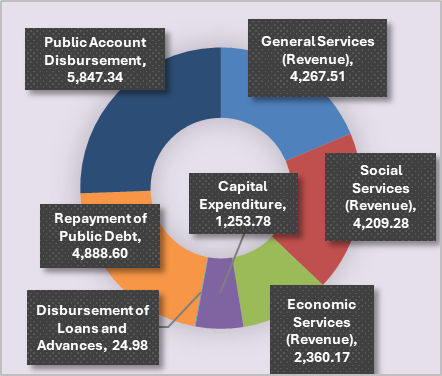
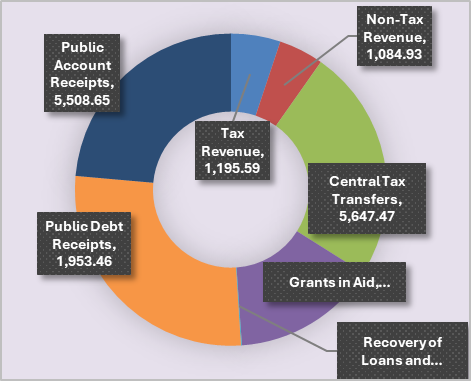
Chart 1 Sources and Application of Resources
( ₹ in crore)
Finances of the State
- During the year 2023-24 Revenue Receipts of the State increased by 11.01 per cent. Own Tax receipts of the State increased by 8.51 per cent and Non-tax Receipts increased by 5.56 per cent.
- State’s Share of Union Taxes and Duties increased by 19.01 per cent and Grants-in-Aid from Government of India increased by 2.31 per cent in 2023-24.
- Revenue Expenditure increased by 7.38 per cent and Capital Expenditure decreased by 5.15 per cent in 2023-24.
- Interest Payments in 2023-24 increased by ₹ 88.02 crore (17.80 per cent) as compared to 2022-23. Expenditure on Interest Payments accounted for approximately 5.10 per cent of Revenue Receipts and 5.37 per cent of Revenue Expenditure for the year.
- During 2023-24, expenditure on Salaries and Wages accounted for 39.87 per cent of Revenue Receipts and 41.99 per cent of Revenue Expenditure. Expenditure on Pension payments accounted for 17.48 per cent of Revenue Receipts and 18.41 per cent of Revenue Expenditure.
Chart 2: Share of Committed and Inflexible Expenditure in Revenue Expenditure during 2019-20 to 2023-24
- Expenditure on Education was 14.02 per cent of Total Expenditure (TE) in 2023-24 fell from 14.67 per cent in 2019-20 and expenditure on Health was 63.63 per cent of TE in 2023-24 fell from 69.40 per cent in 2019-20 to.
- Capital Expenditure of ₹ 523.59 crore incurred on 68 incomplete projects up to 2023 remained blocked.
- Public Debt Receipts increased by 10.68 per cent and Repayment of Public Debt increased by 87.80 per cent in 2023-24.
- As on 31 March 2024 outstanding Public Debt was ₹ 8,703.46 crore out of which ₹ 4,550.66 crore (52.29 per cent) was to attain maturity in the coming 10 years.
Budget Utilisation and Control
- Against the total budget provision of ₹ 17,636.10 crore, State Government Departments incurred an expenditure of ₹ 17,118.18 crore during the year 2023-24.
Chart 3: Budget Utilisation during 2019-20 to 2023-24
- Supplementary provisions of ₹ 698.64 crore during the year 2023-24 in 16 cases (more than ₹ 50 lakh in each case) proved unnecessary, as the expenditure did not come up even to the level of original provisions.
- During 2023-24, there was a total excess disbursement of ₹ 3,446.17 crore under two Grants (5- Vigilance and 27- District Councils and Minorities Affairs) and one Appropriation (49-Public Debt). The excess expenditure requires regularisation by the State Legislature as per the Article 205 of the Constitution of India.
Financial Accountability and Fund Utilisation
- As on 31 March 2024, 32 Utilisation Certificates (UCs) in respect of grants of ₹ 235.62 crore given to the three Autonomous District Councils were outstanding.
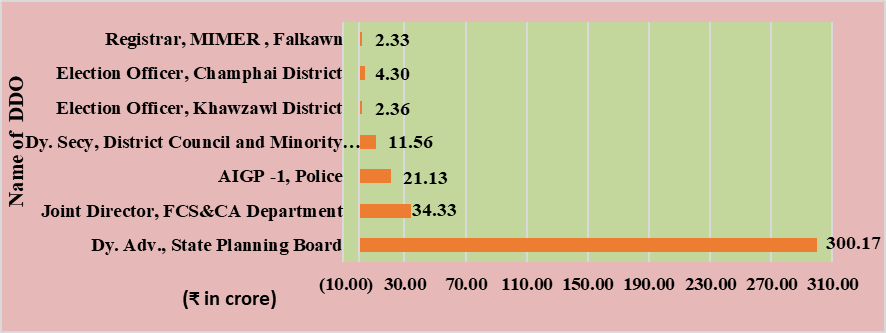
- Detailed Countersigned Contingent Bills in respect of 92 Abstract Contingent bills of ₹ 472.19 crore were not received as on 31 March 2024.
Chart 4: Value of DCC Bills pending for major defaulters at the end of the year
- Five Annual Accounts of Autonomous District Councils/Government Bodies which were due for audit as of 30 September 2024 were not received.
What needs to be done:
- The State Government should adhere to the Mizoram Fiscal Responsibility and Budget Management (MZFRBM) Act, 2006 by practicing prudent fiscal management and remaining aligned with the Fiscal Consolidation Roadmap.
- Additionally, the State Government must ensure timely interest payments on interest-bearing securities and contribute its mandated share to designated reserve funds for accurate fiscal reporting.
- Priority should be given to completing incomplete capital projects to unlock their intended socio-economic benefits.
- The State Government must rationalise expenditure to reduce pressure on public liabilities and enhance debt sustainability.
- Budgetary forecasting and management should be improved to optimize fund usage and uphold fiscal discipline.
- The State Government should focus on regularizing excess expenditure through legislative approval to ensure transparency and accountability.
- Outstanding Utilisation Certificates and Abstract Contingent Bills must be cleared promptly to mitigate the risk of fund mismanagement.